

In an age of YouTube ads and paid political-content creators, the notion might seem quaint. But González, who’s thirty-one, has made it her job to figure out how to use the mail to help elect Democrats. On a projected slide deck, she flipped through examples of mailers that she and her firm had worked on: there was the familiar ALEXANDRIA ¡OCASIO! CORTEZ logo, a lotería-themed postcard that read “VOTE FOR OUR COMMUNITY, VOTE FOR RUBEN GALLEGO,” and another one, paid for by the Dolores Huerta Foundation and decorated with Día de los Muertos imagery, that read “VOTA PALOOZA.” González knows the rules of the game, and shared some loopholes that she’s learned along the way—for instance, that political-action committees cannot coördinate with campaigns, but that campaigns can post information, in hard-to-find corners of their websites, about what kind of advertising they happen to need help with.
After González concluded her talk, an attendee asked about something she had mentioned earlier—that she was Salvadoran, and living in the U.S. under Temporary Protected Status. “I’m so sorry to hear that,” the person said. González, seeming impassive, said, “It’ll work out how it needs to.”
González is one of an estimated two hundred thousand Salvadorans whose legal immigration status is set to expire on September 9th, and one of about a million immigrants in the widening gyre of the Trump Administration’s delegalization drive.
For González, who has lived in the U.S. nearly her entire life, the date is a brick wall of a deadline. “That’s when I sell my house, I sell my car, I buy a ticket, I pack everything I own, I get rid of everything I can’t take with me,” she told me. Unlike most immigrants in America, González has a job that puts her in rooms with powerful people. As a partner at the consulting firm Solidarity Strategies, she tries to help Democrats win some of the most consequential races in the country, including James Talarico’s campaign for Senate, but also smaller names in red districts trying to flip the House.
Her biggest client this cycle is the Democratic
Her biggest client this cycle is the Democratic Congressional Campaign Committee, which has paid her firm more than a hundred and eighty thousand dollars this year, according to the Federal Election Commission. She’s grown friendly with Tony Cárdenas, a client and former congressman from California, who officiated the wedding of her mentor and boss, the political consultant Chuck Rocha.
After the seminar, González returned a missed call from Cárdenas, who’d inquired about a New Yorker reporter asking to speak to him. “If you’d be willing to talk to him, there’s nothing I’m really avoiding,” she told Cárdenas in a voice mail. She turned to me: “He probably doesn’t want to say the wrong thing.”
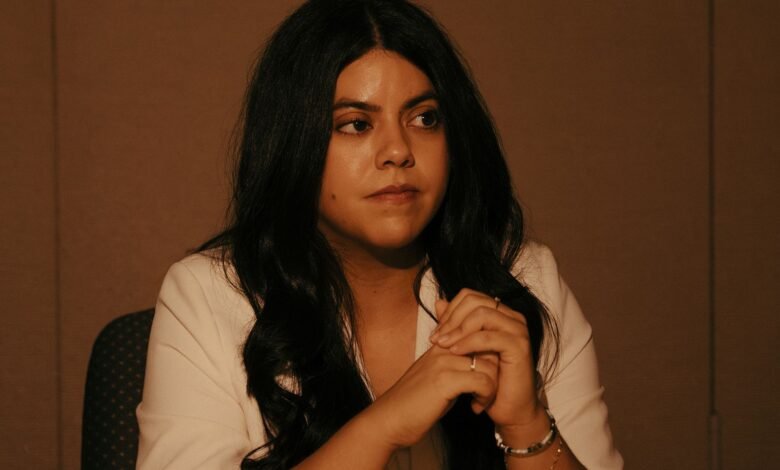
González is introverted, but comes across as warm and cheerful.
She smiles while she talks, except when she’s on the verge of tears. Her colleagues at Solidarity Strategies think that she’s good with people, so they’ve put her in charge of dealing with candidates, Party officials, and campaign committees. “Chuck Rocha don’t need to be over there if I’m gonna have a candidate screaming at me and telling me that I’m stupid,” Rocha, the firm’s founder, who appears often, as a straight-talking, cowboy-hatted commentator, on CNN, told me.
That does not go good for Chuck
“That does not go good for Chuck. But Daysi has a way to tell them that they’re stupid, and to do it in such a nice way.”
Temporary Protected Status gave González the ability to work, but did not qualify her for federal financial aid when applying to college. The Church helped in that regard: González chose Brigham Young University-Idaho, which is heavily subsidized for Mormons.
She was there in the lead-up to the 2016 election, and she recalls a professor noticing her Spanish name. “You better hope Trump doesn’t win,” she remembers the professor saying derisively. When González sought legal advice, a lawyer looked her “dead in the eyes” and asked if she had a boyfriend who she could marry for a green card. But she didn’t want her future to depend on one person; she knew of people whose spouses used the threat of deportation to manipulate them.
She’d been dating someone for about a month at the time, and broke up with him soon after. In 2019, González was introduced to Rocha, who had a reputation as a cultivator of Black and brown political talent. Rocha, who is Mexican American, saw something special in González’s immigrant background. “These types of people have had to figure out how to make it through life any way—they could figure out how to make a piece of mail,” he told me.
He hired González to help with social media,
He hired González to help with social media, manage clients, and do administrative work, but, in time, she started designing ads herself. Soon after she joined, the firm was hired to help run Bernie Sanders’s 2020 Presidential campaign, which meant that González was the only person handling the rest of the clients at the firm’s K Street office; she became an equity partner within a few years.
After that election, as she built her life in a capital governed by Democrats, González grew alienated from her church. “It was jarring to be living here, going through the immigration struggles that I’m going through, and then, like, high-ranking leaders in the Church are MAGA. Why am I associating myself with this?” And she began to worry about her status again in 2024, as the second Trump Presidency came into view.
After Kamala Harris became the Democratic nominee for President, the polling looked bleak enough that González sat Rocha down to talk, anxious that she’d have to leave the country. The life that González had made in America over twenty-five years—the college degree and the career, the house in northern Virginia she owns with her sister, the Honda HR-V she paid off last year—was possible because the question of her status had settled into a cycle of unstable predictability.
New Presidents continued to find that conditions
New Presidents continued to find that conditions in El Salvador merited the extension of the “temporary” status, and she dutifully paid the fees and filled out the paperwork every eighteen months and pay steep fees. (By itself, T.P.S. doesn’t provide a path to a green card or citizenship.) Trump attempted to cancel the status during his first term, but the courts had ruled it unlawful; after he won again, Joe Biden, during his last week in office, approved another eighteen-month reprieve.
González had never got this close to zero before. This past Monday, less than two weeks before the extension was set to expire, she packed up some belongings she’d kept at her office: three pairs of high heels, a pair of fuzzy slippers, a tube of toothpaste. “Having to take some stuff out of my desk—like, I never got that far, other times.”
Rocha said that he would, but he didn’t; he just stopped telling her about it.
As recently as last month, he said, he had talked privately with people who worked in Trump’s White House. “Send me her stuff,” one staffer said, “but also know that this can cut both ways if I raise this too high.” Rocha has many friends in Washington, but his attempts to change González’s situation have left him feeling powerless. “You mean I can’t call a senator?
I can’t call the chairman of the Hispanic
I can’t call the chairman of the Hispanic Caucus and just fix this shit?” he said, raising his arms incredulously. “No matter how many important people you know, no matter how much money you think you have, that you’ve made at this little firm—none of that matters.” He grew agitated thinking of Obama’s decision not to pursue immigration reform when he had legislative majorities.
“Now me and my team are paying for that,” he said, before quickly adding, “nothing against Barack Obama.”
Rocha wishes that the elected officials his firm has worked for would give speeches from the House floor to emphasize that the people ensnared by Trump’s policies are not criminals. But Democrats have become more tentative to speak on immigration since the Obama years.
Andrea Flores, who worked in the Obama Administration and served as a border official under Biden, told me that Biden lacked interest in pushing legislation to regularize the status of longtime residents. The House Minority Leader, Hakeem Jeffries, she pointed out, didn’t even mention immigration in a recent press conference announcing an agenda of Democratic priorities should they retake the majority.
There may not be an immediate electoral gain
“There may not be an immediate electoral gain in prioritizing immigration,” Flores said, “but there is an absolute electoral risk and loss by allowing the system to be as dysfunctional as it is, and allowing the Republican Party to continue to weaponize that dysfunction against Democrats.”
Rafael Collazo, the executive director at UnidosUS Action Fund, a Latino civil-rights advocacy group and a client of González’s, told me that her case should underscore a “failure of leadership” in D.C.
that “we’re all responsible for.” “But,” he added, “in particular, Congress, and, in particular, the people that claim to be more progressive on immigration issues—the Democratic Party, Democrats in Congress—they haven’t done enough. None of them have done enough.”
González is planning to go back to El Salvador—a place where she has few relatives left, and where, although Rocha has offered to keep her as a remote worker, she’s not sure she’ll be able to keep her job.
Then she’ll try to immigrate to another country, such as Spain. (Spain offers a digital-nomad visa, with a fast-tracked path to citizenship for Latin American nationals—“Like a sort of reparations program,” she said.) She’d started documenting her final month of T.P.S. on Instagram, initially hoping to catch the attention of someone in government, but she now thinks of the videos as more like “diaries.” In one, she notices that she’s out of rice, and laughingly considers whether she should bother buying another bag.
On work calls, González told me, there’s now
On work calls, González told me, there’s now a preamble: “ ‘I’m so sorry you’re going through this, like, let me know if you need anything. But when is that mail going to drop? Have you had the chance to get the invoice out?” And even though she works to elect Democrats, González said that the candidates whom she helps elect may have little to say about her case. “I don’t know what more they could add, other than like, ‘Damn, that sucks,” she said, before putting on a politician voice: “And that’s why I want to win and fight for immigrants.” Cárdenas, when reached by phone, said something along those lines: “Should Democrats do more?
Yes, and the opportunity to do more is really going to be in their hands when they control the House, when they control the Senate, when they control the Presidency.” While in Congress, Cárdenas helped González navigate her immigration status and the attendant anguish that came with it. He left after twelve years in 2025, feeling like he could’ve done more—but, then again, he added, “I worked my butt off, man .
. . and you only have so much staff.”
How would you spend your last days in America? For González, the natural answer involves BTS concerts. She’s become a superfan since Trump was reëlected, and has found community in the fandom. On Friday, she boarded an early flight to Los Angeles to attend the final show in the North American leg of the K-pop group’s world tour. She had gone to the band’s concert in Baltimore about a month earlier, and got home at four in the morning.
“As the concert was ending, people around me were probably, like, ‘Oh, she’s crying because the show’s over, she’s a diehard fan,’ ” she recounted. That was part of it, but also, “I knew that I was going back to this mess, and that the countdown’s started, right?” Her favorite BTS song is “00:00 (Zero O’Clock),” a melancholy anthem about uncertainty, and starting over.
Source: www.newyorker.com