

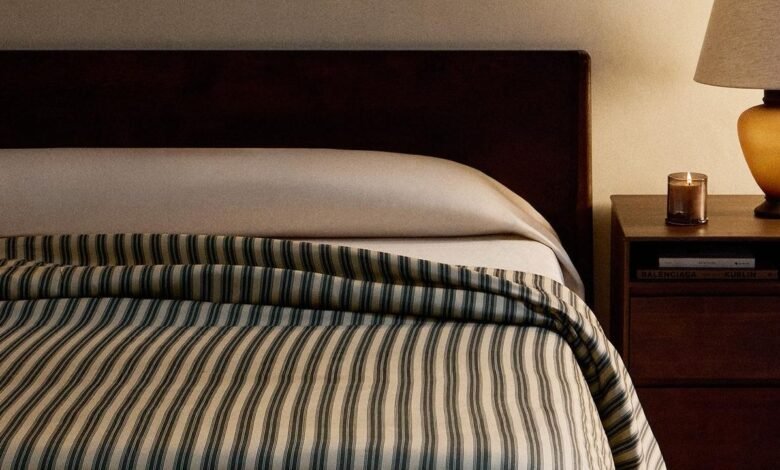
As the days grow shorter and the temperatures drop, there’s nothing quite like knowing there’s a warm, welcoming bed awaiting you at home to usher in a good night’s sleep (followed, ideally, by a long, languorous morning). If ever there were a season that invites spending more time in bed, it’s this one—so it’s high time to put a little effort into creating your perfect set-up.
“You want the bed to welcome you upon walking into the room,” says Patrick Williams, founder of Berdoulat. “I believe there’s a balance to be struck between considered juxtaposition of fabric and color, and an inviting, relaxed, laissez-faire look.” The question of how to make a bed seems simple enough—after all, it’s a task one masters as a child—but to get it to the next level, a few extra steps can go a long way.
It’s the difference between good-enough and hotel-quality. With this in mind, we tapped a few interior designers to see how the pros style their beds; here’s what works, what doesn’t, and what will take bedtime from functional necessity to daily luxury. Consider forgoing a duvet—but layer up
The prospect of a bed without a duvet may seem like a step too far, especially in colder climates—but Heidi Caillier insists it’s worth reconsidering.
I do not use duvets or comforters, she
“I do not use duvets or comforters,” she says. “I don’t like how lumpy they are and personally find them uncomfortable to sleep under.” Her secret lies in layering: start with a crisp bottom sheet, then build warmth and texture with quilts and blankets in a mix of colors and patterns. “It feels more collected and less perfect,” she says. If you’re not yet willing to part with your duvet, then try layering pattern instead.
Per Williams: “A bed with solely one-colored bedding can feel rather ominous to me, so I love varying texture and color or tone. There is a lovely moment of discovery when getting into the bed and seeing, let’s say, a ticking stripe pink and blue sheet beneath an otherwise very neutral ochre linen set.” A floral pattern–as with Anthropologie’s rose-printed sheet–works well here.
What to do with your pillows
While some like a bed well-endowed in the pillow department, most of the experts I spoke to agreed that too many is not a good look. If the bed is a double, Cailler’s styling formula is typically four sleeping pillows (two on both sides) placed one on top of the other, plus one single decorative pillow in front. “I prefer to keep these smaller and strongly dislike the large European pillows,” she says.
You also can’t go wrong with a single
You also can’t go wrong with a single long lumbar cushion—see, the below velvety ochre one from Soho Home. With her clients, Katie Monkhouse keeps things minimal with just one large lumbar pillow and a throw on the end of the bed: “This combination is usually enough to make it feel stylish but inviting,” she says. “Try pulling the top blanket up and over the sleeping pillows and then rest the long lumbar in front for a clean, minimal look.”
Quilts and eiderdowns are a yes
Great for both warmth and aesthetic appeal, quilts, bedspreads, and eiderdowns are having somewhat of a moment.
“American designers have always had a thing for English country style and creating that layered, cozy, slightly nostalgic look; things like eiderdowns and quilts fit into that well,” says Cinny Aumonier. “The combination of down and detailed stitching creates a plump, sculptural quality that gives the bed real presence.” Choose a minimal solid color or something in a punchier pattern, like JW Anderson’s tangerine-and-tomato blanket, to give this traditional textile a mod spin.
As for the designer-lovedhoe and personally use a quilted one from Parachute Home all the time,” says Caillier. “I also love vintage—I’m always looking for new and interesting bedding re a little drama
Try framing the bed with either a fabric canopy or curtains—see the latter in the peaceful room above from Buchanan Studio
We wanted to soften the geometry
“We wanted to soften the geometry of a perfectly symmetrical master bedroom and bring in a sense of calm and sensuality, so we added curtains on an oversized curved curtain pole—when drawn, they almost create a room within a room, and when open, they still offer a cocoooned and private world within the main space,” co-founders Charlotte and Angus Buchanan explain. It wasn’t a simple installation, but the effort was worth the squeeze.
A fabric canopy is a little easier to execute, but no less impactful. Tori Murphy created her best-selling line of striped canopies as a way to bring texture and warmth to the bedroom. “A simple trick to recreate a similar effect is to hang a curtain rail behind your bed—above the headboard if you have one—and drape your chosen fabric from it. It looks incredibly striking but is also deceptively easy,” she says.
Even a plain cotton or linen can bring a sense of serenity to your space. As for those in the market for something more opulent—a four poster bed will definitely fit the bill. What not to do
The resounding advice from every expert? “Don’t overcomplicate it. Too many decorative elements can make a bed look fussy and too staged,” says Monkhouse. Williams agrees: “I am not a fan of overly dressed beds where one must deconstruct and remove piles of cushions to gain entry,” he says.
Blankets, quilts, and cushions are there to be used; they’re not purely for show. … and don’t forget to stock up on the basics:
For the ultimate hotel-worthy comfort, the Buchanan design duo recommend starting with an excellent quality mattress and mattress topper—the latter should be between two and three inches thick for a cloud-like feel—and picking the right basics from there.
Coyuchi, Parachute, and Brooklinen all make reliably great sheet sets.
Source: www.vogue.com