The DVF Awards Celebrated Extraordinary Women—and Honored the Legacy of Gloria Steinem

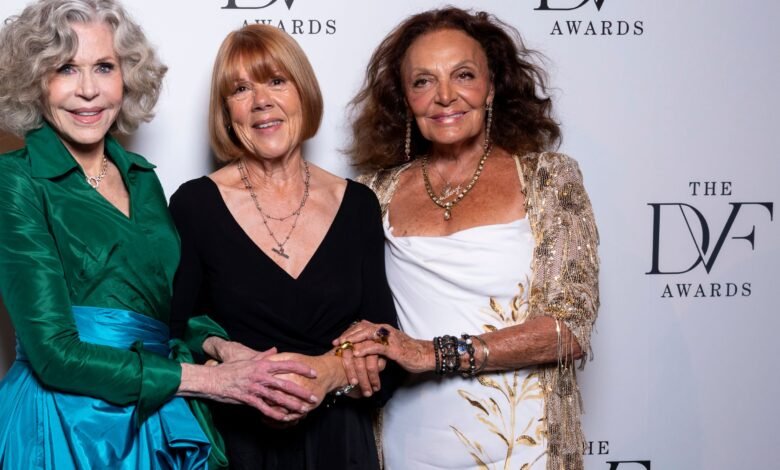
Venice, where Diane von Furstenberg now calls home, is a city that she describes as “a woman who is seductive, and offers solutions.” On Thursday evening, her beloved city—that problem-solving seductress—provided the setting for a gathering of women who tend to make things happen rather than wait for them to happen: the 17th edition of the DVF Awards. But this year, the evening at the jewel-box Teatro Goldoni carried a deeper resonance.
Following the news of Gloria Steinem’s death at 92 that same day, the celebration was dedicated to the trailblazing feminist who irrevocably changed the way the world thinks about women. (Steinem herself was honored with a DVF Award in 2014.)
The chance to honor her legacy made for a poignant coincidence for an evening devoted to female power, and a reminder that, however much has changed since Steinem first began shaking things up, there is still plenty to do.
Steinem’s spirit and presence were felt in a room designed, in many ways, in her image. “Gloria was gorgeous”, recalled von Furstenberg. “She was glory, her name was literally Glory. She was a glory, and she gave glory to women. She definitely earned her name. She stayed forever young, eternally a student. And such a badass. She refused to be a victim.”
It’s a lineage von Furstenberg herself has carried forward since 2010, utilizing her own awards platform to spotlight women who don’t simply talk about change—but get on with enacting it.
Together with the Diller-von Furstenberg Family Foundation, the prize
Together with the Diller-von Furstenberg Family Foundation, the prize recognizes and support extraordinary women dedicated to transforming and inspiring the lives of other women, with each recipient granted $100,000 towards their nonprofit organization in order to further their work. This year’s five honorees offered an expansive definition of what that can mean: actress and lifelong activist Jane Fonda; Gisèle Pelicot, the French survivor who turned a deeply personal ordeal into a public demand for justice; Barbados Prime Minister Mia Amor Mottley, who has become one of the Caribbean’s most outspoken voices on climate justice, debt, and global inequality since she was elected as the country’s first female leader in 2018; photojournalist Lynsey Addario, whose career has taken her into some of the world’s most dangerous places; and Kenyan educator and entrepreneur Wawira Njiru, whose Food4Education initiative provides school meals to children and has grown into one of Kenya’s largest school-feeding programs.
All five spoke with the charisma their honors demanded, but none more urgently than Addario—fresh off an assignment in Madagascar and already bracing for the West Bank in October—who touched on what she called journalism’s most precarious moment. “When I started photographing, my mantra was, ‘If I have a photo, it happened because I was there. Now you can’t even believe it if there is a photo,’” she said, reflecting on media’s credibility struggle in the age of AI and on the repeated attacks on freedom of speech.
On the work itself, amid coverage of Ukraine, Sudan, and Gaza, she added: “I get a lot of strength from the people I photograph. They still have strength and they still have hope. I really believe that photos and relationships and communication can make a difference. Add that to empathy and compassion, and it’s my contribution; it’s where I can feel useful in a time where things seem very overwhelming.”
Where Addario has spent her career behind the camera, often alone and unseen in places most people try to avoid, Fonda has done her fighting on the world’s most prominent stages.
At 88, she looked divine in a dramatic
At 88, she looked divine in a dramatic gown in rustling green taffeta, her glamour not an inch dimmed by her age. An actress, Oscar winner, and political activist since the Vietnam era, she has spent decades moving between Hollywood and the barricades, most recently becoming one of the most visible voices of the climate movement. The fire of Fonda’s convictions is still magnetic; she spoke emotionally of Steinem, whom she knew closely.
“One of my favorite quotes of hers was, ‘It’s not that women are morally superior to men. It’s just that we don’t have our masculinity to prove,’” she said. While the state of the world is in turmoil, she offered hope. But “hope and optimism are different,” she argued. “Optimism is saying, ‘Everything is all right.’ But you don’t do anything to make it so.
Hope comes with action. It’s a muscle. And the reason that I can be hopeful is because I’m giving everything I have to try to make things be right again.”
Five women, five very different battles. The common denominator was not celebrity, wealth, or even profession. It was the slightly old-fashioned idea that having influence should come with some responsibility to use it. Which brought the evening back to Steinem, to whom von Furstenberg dedicated the entire soirée.
It was impossible not to think
It was impossible not to think of the extraordinary arc between the woman who spent the 1960s and ‘70s making feminism impossible to ignore and the women now carrying the argument forward in entirely different forms. Steinem always understood that visibility was power. Von Furstenberg, who built a fashion empire around a silhouette that empowered women to be in charge of their own bodies and lives, always got the memo, too.
Each, in her own register, has been a strategist of image as much as substance: a message doesn’t spread on conviction alone; it needs a rallying cry, a face people can’t look away from, even a dress. Style can be a tool to help a strong message land. There was something particularly fitting, then, about celebrating this group in Venice. Because the DVF Awards are not really about women being inspirational in the abstract.
They are about women being useful: taking an idea, an apparently insurmountable obstacle, a talent, or an experience, and turning it into action. And if Gloria Steinem’s death cast a shadow over the evening, it was a shadow with a long reach. The women in the room were, in one way or another, standing on ground she helped clear. Which is perhaps the best kind of tribute: not looking backward for too long, but getting on with the work.
Gisele Pelicot;Diane Von Furstenberg Jane Fonda Karlie Kloss
Gisele Pelicot;Diane Von Furstenberg Jane Fonda Karlie Kloss Wawira Njiru Huma Abedin ?;?;?;?;Antonia Karra Amina Mohammed;Kulsum Shadab Wahab;?;Silvia Negri Firman Carolina Fullin;Simone Venturini Lynsey Addario Magaajyia Silberfeld Amin Jaffer;Tina Brown Laurent Claquin;Martina Mondadori;Nick Brown Anna Castellini Baldissera;Orson Fry;? ?;? Anita Hill;Jane Fonda Reem Al-Hajajreh;Yael Admi Amina Mohammed;Mia Mottley Tina Brown;Barry Diller Jane Fonda;Gisele Pelicot;Diane Von Furstenberg ?;Wawira Njiru;?
Noa;Mira Awad;Caroline Darian;Karlie Kloss;Wawira Njiru;Amina Mohammed;Gisele Pelicot;Diane Von Furstenberg;?;Jane Fonda;Anita Hill;Lynsey Addario;Tina Brown;Simone Venturini
Source: www.vogue.com