

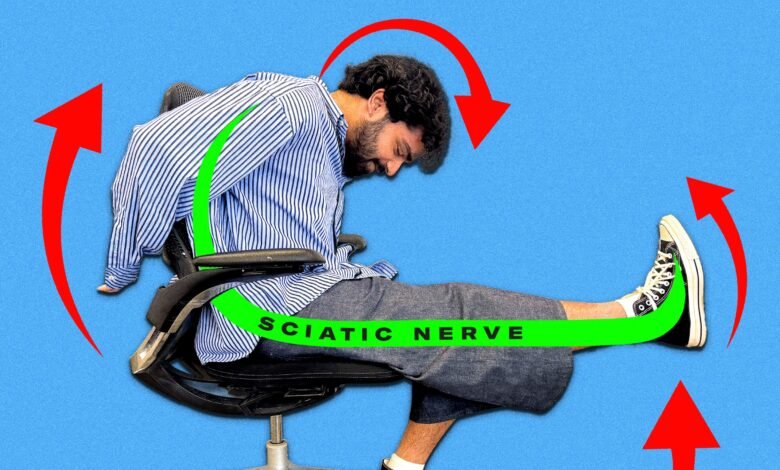
Lately, you might have noticed a new back pain remedy floating around your socials. Then again, maybe that’s just what happens when you leave a microphone-enabled smartphone in the vicinity of a grizzled reporter who spends too many hours hunched over a laptop and, as a result, has the posture of a comma. Either way, it seems wellness influencers have recently taken an interest in “nerve flossing”—a relatively simple, instant (albeit temporary) form of relief from nerve-related pain.
Is it worth the breathless hype? Perhaps not, as we’ll explain. But for a certain subset of people, it could make a real difference. It is, as Raj Desai, MD, a double board-certified physician at DISC Sports and Spine Center, puts it: “better than most internet advice, weaker than the enthusiasm suggests.”
So what exactly is nerve flossing? And who actually stands to benefit?
Also, why do experts recommend it in spite of a body of research that one physical therapist describes as “a very gray area?” Here’s everything you need to know. What is nerve flossing? Nerve flossing, also known as nerve gliding or neural mobilization, is essentially a way of freeing up a nerve from any potential sticking points that could be causing pain or discomfort. Similar to how you might move through a yoga flow to shake the rust off your range of motion, nerve flossing movements are designed to restore mobility to the nerves.
Think of it as exercise for a nerve
“Think of it as exercise for a nerve instead of a muscle,” says Dr. Desai. For the most part, these exercises are seemingly basic, consisting of just subtle movements. One example, what Dr. Desai calls a “slider,” involves simply sitting on an elevated surface and extending one leg out in front of you while tucking your chin, and then reversing the movement to bend your knee as you tip your head back.
“It lengthens the nerve at one joint while shortening it at another,” he explains, “allowing the nerve to glide back and forth along its path without much tension.” Hence, “flossing.”
Basically, after exiting the spinal cord, our nerves travel through muscle, fascia, and all sorts of connective tissue on their way to the furthest reaches of the body. At any point along that path, they can get caught or irritated.
“As a result, the nerves themselves can get inflamed, which can be aherapist at Houston Methodist Orthopedics and Sports Medicine. “Nerve flossing is a technique that uses gentle, controlled movements to help a nerve move more freely through the surrounding tissues. I often describe it as helping a nerve ‘slide and glide’ the way it’s supposed to.”
Who actually needs this?
Nerve flossing has been found to be effective
Nerve flossing has been found to be effective in treating pain in cases where a nerve has become compressed or irritated—including conditions like sciatica, carpal tunnel syndrome, thoracic outlet syndrome, and potentially others. “Whether or not it’s the right tool for what’s actually driving your symptoms is somewhat hard to tell sometimes, but if you ever get that nagging, nerve-type pain where it’s more of a vague, burning sensation in the area, it could potentially help,” says Dr.
Hedt. That’s a pretty good deal for something that takes just a couple of minutes and doesn’t require any equipment (or a co-pay). But it’s also about as far as the benefits of nerve flossing go. “It’s more of a pain management treatment,” says Dr. Desai. “Nerve flossing isn’t going to heal the underlying issue of your sciatica, which is typically a herniated disc. The only thing that’s going to do that is physical therapy, core strengthening, and possibly surgery.”
Does nerve flossing really work?
The research surrounding nerve flossing is surprisingly murky. A 2023 meta-analysis published in the journal Life pooled 20 randomized trials and found that nerve flossing significantly reduced pain in patients with lumbar radiculopathy—a pinched nerve in the lower back. “That sounds decisive, but it isn’t,” says Dr. Desai. “The heterogeneity was extreme, meaning the trials disagreed with each other far more than chance explains, and most of the studies were small, ran for just two to six weeks, and couldn’t blind patients to a hands-on treatment.”
“It’s a very gray area,” says Dr.
Hedt. This type of thing is hard
Hedt. “This type of thing is hard to validate and quantify in research. We ourselves have tried to develop a few studies, but it’s really hard to do, because you can’t just stick an electrode inside the nerve and see what it’s doing.” Nonetheless, the physical therapists who spoke to GQ seem generally comfortable prescribing nerve flossing to patients whose pain might be stemming from nerve issues.
“For the most part, it’s a fairly low-risk thing to do,” says Dr. Hedt. “And so while the evidence doesn’t necessarily support it, it still is a, the bottom line is that nerve flossing isn’t going to correct any issues, but it could make things like sciatica or carpal tunnel syndrome more bearable while you seek proper treatment
“In my opinion, it’s free, it takes two minutes, and it produces a sensation that you can feel immediately,” says Dr. Desai. “So it has the advantage of being at least partially true—which, in an age where most things that go viral in this category aren’t, I would say makes it worth trying. Just don’t expect it to be a cure.”
Source: www.gq.com