

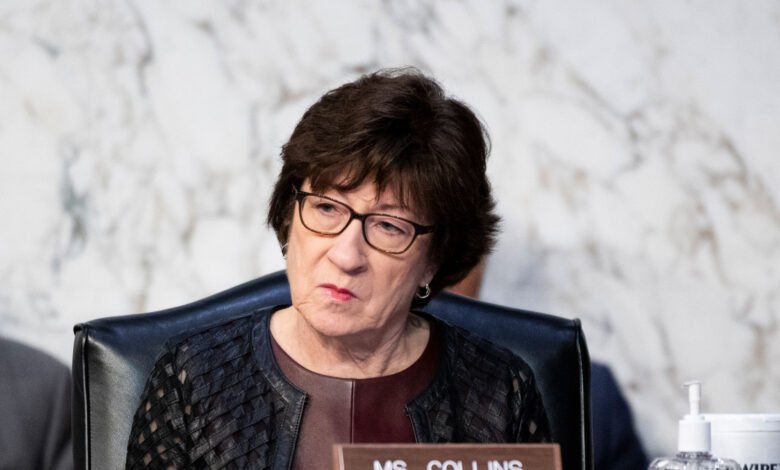
Many women who backed the Republican incumbent for years now point to her role in confirming Brett Kavanaugh
PublishedSeptember 7, 2026 6:00AM (EDT)
Sen. Susan Collins, R-Maine (Bill Clark/CQ-Roll Call, Inc
This story was originally published by The 19th.
This story was originally reported by Shefali Luthra of The 19th. Meet Shefali and read more of their reporting on gender, politics and policy.
Lisa Kushner still recalls the fear and anxiety she felt upon learning she was pregnant.
Kushner has lived in Maine for about 50 years. But at 19, she was a college student in New York, where abortion was illegal.
It was 1966. The Empire State wouldn’t legalize abortion for another four years, and it would be three more before the Supreme Court would rule in Roe v. Wade that the U.S. Constitution guaranteed the right to an abortion.
At the time, Kushner knew she couldn’t stay pregnant. She was the first in her family to go to college; if she became a mom, she didn’t know how she’d be able to stay in school, let alone get her degree. It was “a tense, miserable time,” she said.
So she called every woman she could think of until someone recommended a medical provider in New Jersey, someone discreet and capable who could perform an abortion for her. He worked out of what looked like a dentist’s office in a dark, empty office building in Newark, which she entered through a side entrance in an alley. Kushner’s father, who had worked as an Army mechanic in World War II, told her years later that he had never been more terrified than when he took her to have that abortion.
When the Supreme Court issued its landmark abortion decision in 1973, Kushner thought the issue was settled — that people would no longer have to experience the same fear and uncertainty she did 60 years ago.
“We thought this fight was over,” she said. “And we were wrong.”

(Courtesy of Lisa Kushner)
Kushner, now 80, graduated from college and pursued a career in family planning and social work. She got married. She got divorced. She remarried and had children. She then settled in Maine. In the past, she voted for Susan Collins, Maine’s Republican senator and an institution in state politics, who has long touted herself as a moderate lawmaker and supporter of abortion rights.
Now, Kushner is volunteering to unseat the Republican incumbent, who has been in office since 1997. Abortion is a big reason why.
Women over 60 are largely past their reproductive years and may not be directly affected by abortion bans. Yet for many, the issue still feels deeply personal. The 19th spoke to five women voters over 60 in Maine, several of whom expressed concern about the consequences abortion bans could have on their descendants. None of them called abortion her sole reason for voting against Collins, but all highlighted the senator’s vote for Brett Kavanaugh, who played a critical role in the 2022 decision to overturn Roe, as a breaking point in their ability to trust her. Several said they believe she has prioritized President Donald Trump’s interests rather than those of the state.
“It’s not just us. We’re talking about our children,” said Elayne Richard, 72, who lives in Fairfield, a small town in central Maine, and volunteers with local abortion rights organizations, including a group called Grandmothers for Reproductive Rights, known and pronounced as “GRR.” “And some of our children are not going to have to worry about abortion care, but our grandchildren and our great-grandchildren.”
Collins, arguably the most vulnerable incumbent Republican this election, is relying on her reputation as an independent voice in Washington, someone who puts Mainers first. But polls suggest the longtime senator is running neck-and-neck with Democratic challenger Troy Jackson, whose campaign has emphasized Collins’ vote for Kavanaugh.
“Susan Collins had convinced Mainers she was pro-choice. The Kavanaugh vote was very problematic for her, and her numbers have never been the same since,” Celinda Lake, a veteran Democratic pollster, told The 19th earlier this summer.
Start your day with essential news from Salon.
Sign up for our free morning newsletter, Crash Course.
Planned Parenthood’s advocacy arm is spending more than $600,000 on advertisements linking Collins to the end of abortion rights. Reproductive Freedom for All, a national nonprofit that supports abortion rights, endorsed Jackson at the end of August.
“Even now, Collins proudly says she doesn’t regret her vote, and while she will keep making excuses for her actions, Troy will keep fighting to repair the damage she caused and restore abortion rights nationwide,” said Maggie Amjad, a spokesperson for Jackson’s campaign.
If that strategy works, it will be because of women like Kushner and Richard — women in their 60s and older, whom Collins has historically relied on for support and are broadly inclined to support abortion rights. Women make up themajority of voters in Maine, which is on average the oldest state in the country, with a median age of 44.8 years.
The Kavanaugh emphasis isn’t a new approach. It was a key focus in the failed 2020 effort to unseat Collins. Strategists for Graham Platner, the former Democratic nominee who withdrew from the race in July after Politico reported on allegations of sexual assault, also had planned to highlight abortion, Collins’ vote and the subsequent fall of Roe v. Wade. This is Collins’ first reelection campaign since the overturn of Roe.
A spokesperson for the Maine AARP said that abortion had not emerged as a top election concern for the chapter’s members, pointing instead to financial security, caregiving, utility costs and healthcare affordability.
Still, “if you’re going to mobilize older women voters, then you will mobilize a population or group that is more likely to support abortion access,” said Ashley Kirzinger, a Maine-based national pollster with KFF, the national health policy research, journalism and polling organization.
She has seen anti-Collins ads that highlight two issues: abortion rights and healthcare availability in the wake of Republican-backed cuts to Medicaid, the health insurance program for low-income people.
“It’s heartbreaking as an older person to think, this is what the last chapter of my life is going to be — watching the future my children have to live through become darker and darker instead of brighter and brighter,” said Elizabeth Leonard, a retired historian in Waterville who taught at Colby College. “I’m way past menopause, thank God, but I care about other people.”
Collins’ support for Kavanaugh has influenced Leonard’s vote, she said, but so has the senator’s broader voting record, which Lenoard described as being “hand in glove” with Trump. (She did note Collins’ role in both Trump impeachments, in which the senator once voted to acquit and once to convict the president.)
She said she did not support Platner and would have struggled to vote for him had he stayed in the race. But Jackson’s ascent has changed things for her, she said.
“I am throwing myself into Jackson’s race in a way I never could have for Platner, and I know other people are, too,” she said.
Richard, who worked at an abortion clinic in Louisiana in the late 1970s, moved to Maine in 1980. She quickly became pregnant. She and her husband were elated — and, she said, experiencing something as transformative as pregnancy underscored for her that “you can never question a woman when she is like, ‘I need to have an abortion.’”
Sarah Mahoney, who lives in Arrowsic, Maine, voted for Collins in 2008 — an election in which she also voted for Barack Obama. She was struck at the time, she said, by Collins’ record as a Republican who supported abortion rights. Voting for her felt like a vote for a less polarized country.
Now, Mahoney, 65, is “mortified” by that vote. When the Supreme Court overturned Roe, she found herself thinking about what it would mean to be a young woman in Dallas, the city where she lived as a 20-something in the 1980s, and where she got a legal abortion.
“I probably got my period in 1973, which was when Roe passed,” she said. “My whole reproductive life was lived safely within the confines of Roe v. Wade, and my kids don’t have that.”
- AI’s abortion misinformation problem
- Texas and Georgia races show voters are finally sick of MAGA corruption
- Missouri Republicans are trying to repeal abortion rights by leaning into anti-trans sentiment
ByShefali Luthra
Related Topics ——————————————
AbortionRepublicansSenateSusan CollinsThe 19th
Source: www.salon.com