

On a recent sweltering morning, Sachs, now sixty, stood outside his sprawling SoHo studio, on Centre Street—where he has been making art for the past forty years—thinking, yet again, about a window display. For his latest work, “31 Rue Cambon,” an immersive installation that opens to the public on September 11th, during New York Fashion Week, Sachs converted part of his studio into an uncanny simulacrum of the luxury fashion house Chanel’s flagship boutique, in Paris.
Viewers will enter directly from the street, where Sachs and his team of around twenty people were in the process of re-creating the iconic Chanel storefront, with cream-colored awnings made of cardboard and wrought-iron gates emblazoned with the brand’s interlocking “C”s. Inside, viewers will find a mirrored entrance hall and a showroom stocked with handbags, shoes, sparkly baubles, and Chanel’s signature two-piece suits—all painstakingly handcrafted out of everyday materials such as cardboard, paper, plywood, and broken glass.
Sachs, who has the garrulous, jittery mien of a hyperactive teen-ager, explained that he intended to conceal the exterior till the last possible minute. “We’re keeping butcher paper up on the windows until we open,” he said. “I think shock and awe is best.”
This is not the first time Sachs has repurposed Chanel’s enduring iconography in order to shock: in 1998, he made a giant, fully functional guillotine out of stolen police barriers and covered it in Chanel logos—in part, he has said, to make a statement about “cultural fascism.” (The piece now resides in the permanent collection of Paris’s Centre Pompidou.) Over the years, Sachs, whose work is also found in the collections of the Metropolitan Museum, the Museum of Modern Art, and the Guggenheim, has positioned himself as a cultural provocateur who re-creates loaded objects and spaces—he’s made a toilet plunger out of Hermès wrapping, a McDonald’s meal from Tiffany packaging, and a model of a Nazi death camp stamped with Prada insignia—in what he has called a dual exercise in “brand critique and brand affection.” But “31 Rue Cambon” may be his most comprehensive engagement with consumerism yet, and it comes at a moment when Chanel frenzy is at a newfound high, thanks to the brand’s creative director, Matthieu Blazy.
(The French label reported a revenue increase
(The French label reported a revenue increase of about sixteen per cent in the first half of 2026.) “This store, for me, is real, even though you cannot buy anything in it,” he said. “Maybe, in a way, that inaccessibility makes it feel more real. For me, the lust for consuming things is replaced by making them.” As a maximalist Gesamtkunstwerk, it echoes another of Sachs’s major works, “Space Program,” which débuted at the Gagosian gallery, in 2007.
For that, he built a spacesuit, a NASA command center, and a to-scale lunar module out of plywood, plumbing, and found materials. Most recently, he showed a collection of his furniture design at the Upper East Side gallery Salon 94. On Centre Street, Sachs pointed toward a chandelier in the entrance hall, reminiscent of one in Coco Chanel’s Paris apartment; he and his team built it out of cast-iron woks, Citi Bike reflectors, and lead fishing sinkers.
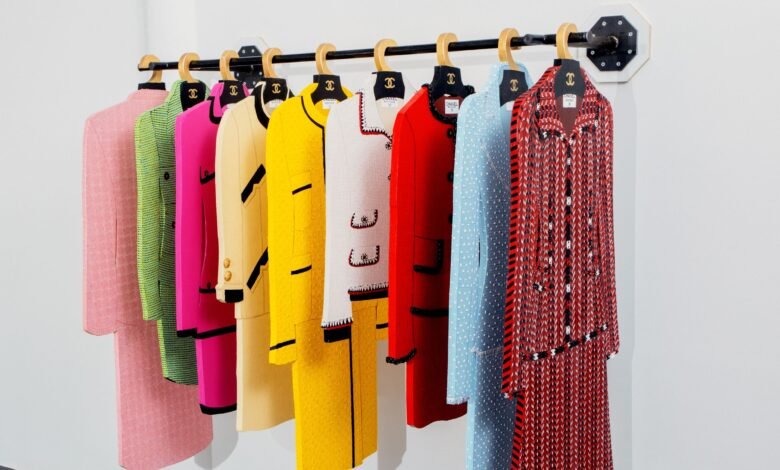
He pushed through a mirrored panel to reveal the main boutique, where, around the room’s perimeter, a dozen or so flat Chanel “suits,” all painted on slabs of three-quarter-inch plywood, were hung up like dream clothes for a life-size paper doll. Coco Chanel began creating suits for women in the nineteen-twenties, but it was a design of hers from 1954—a tweed skirt with a boxy, collarless matching jacket—that became one of her most recognizable silhouettes.
Since then, Chanel suits have been worn
Since then, Chanel suits have been worn by style icons from Marlene Dietrich to Michelle Obama. The current version of the ensemble retails for more than ten thousand dollars. A Sachs suit sculpture, by contrast, requires “maybe seven dollars’ worth” of materials. The value, he told me, is in the labor: each one took more than ten days to produce, as he and his team mimicked individual textiles by using experimental techniques.
To make a famous ivory-navy-and-red bouclé suit worn by Coco herself, for example, the team used combs from Walmart to crosshatch the paint’s surface and added dollops of paint to imitate bouclé’s popcorn texture. The hand-painted gold buttons, decorated with ornate laurel wreaths, are tiny works of art in themselves, shaped out of sculpted polymer. Thirty-one suits in total will be on view, mimicking those worn by celebrities such as Naomi Campbell, Elizabeth Taylor, and Olivia Rodrigo, whom Sachs calls “the muses.” A rickrack trim on one suit was made by a staffer piping a wriggle of paint out of a syringe and then smooshing it with wax paper; the look of rough tweed on another was evoked by mixing paint with pumice gel.
The accessories featured similar contrasts: a Gripoix brooch of diamantés and Lego elements (the “jewelry” will be presented in a sleek set of glass-fronted drawers and a wall-mounted cabinet), and, nearby, a cardboard facsimile of classic Chanel pumps with stacked wooden heels. Sachs ran his hands over a powder-blue suit, modelled on one worn by Princess Diana. “Sometimes I come into the studio and, like, start crying,” he said.
Because we’re having so much fun
“Because we’re having so much fun. The things that we’ve come up with are so fucked up!”
In recent years, however, Sachs has faced criticism that his studio was not so fun; in 2023, several former staffers accused him of fomenting a toxic and cultlike workplace. Sachs denied specific allegations of harassment, but he did face consequences. Nike, with which he’s put out limited-edition sneakers since 2012, dropped him, though it renewed the relationship a year later, and Sachs had to issue a public apology and undergo sensitivity-and-awareness training.
When I asked him about the allegations, he balked a bit. “I’m not sure how much more I can possibly add to what I’ve already said,” he said. “I will say I’m proud of the work that we’re doing here. I could not have done a show of this complexity without an incredibly dedicated team who shares the vision of this.”
Indeed, his team, which works out of a carpentry shop in the basement and a painting studio upstairs, did seem dedicated; I observed a cadre of young artisans gluing hundreds of seed-size rhinestones onto plastic bezels to evoke the look—if not the price—of lavish jewelry.
“For me, this show is not about Chanel,” Sachs said. (In fact, he hasn’t spoken to anyone at the brand about the project.) “It’s about honoring and obsessing.” ♦
Source: www.newyorker.com