

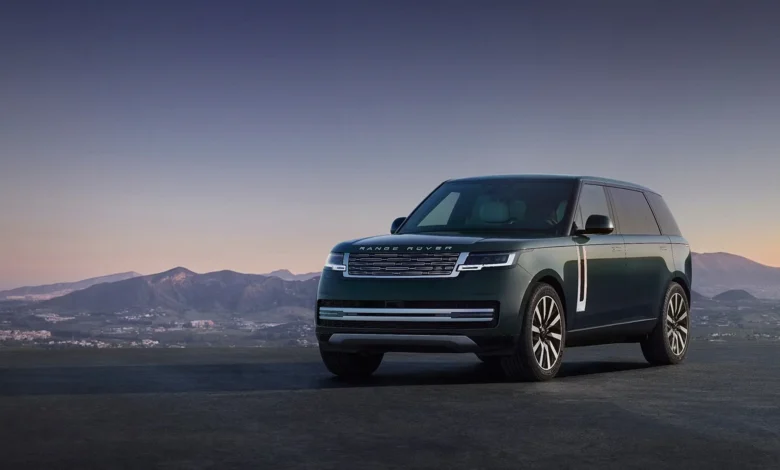
Range Rover spent about a decade developing an EV that looks like a regular Range Rover. Ferrari took a different road.

Park the new Range Rover Electric next to the gas-powered version, and the differences take a while to find. On the EV, the grille has been filled in, the wheels are new, and the underbody has been reworked. Between them, those changes trim the drag coefficient by 0.01 and add up to 10 miles of highway range. The three-line profile and the floating roof are untouched, as are the proportions the nameplate has carried since 1970.
That restraint took a surprising amount of work, with a hefty cost associated. JLR spent roughly a decade developing the car and filed more than 300 patent applications along the way. It retrained around 9,000 workers at its Solihull plant outside Birmingham, England, and another 1,500 across the surrounding region. Plus, JLR installed new battery and electric drive unit lines at a second site in Wolverhampton. The car was promised for 2024, then 2025, and only opened for orders this week. But what arrived this September was a vehicle most people would not be able to identify as electric from across a parking lot—which was precisely the brand’s intention.
Range Rover’s executives spent the reveal repeating what
Range Rover’s executives spent the reveal repeating what their customers had told them, which essentially amounted to a request to leave the car alone. Thomas Müller, JLR’s executive director of product engineering, had described the same plan when the waiting list opened in late 2023, saying the ingredients behind Range Rover’s success were unchanged: timeless, reductionist design, a serene cabin, and go-anywhere capability, now with no tailpipe emissions.
The decision under the sheet metal
A battery gives designers some additional freedom that a V8 petrol engine simply does not. No engine block means a shorter hood, a flatter floor, a cabin pushed forward, and a shape that can be drawn around aerodynamic efficiency rather than around cooling and packaging. Most manufacturers have taken advantage of the freedom to be able to change the design, partly because it is the cheaper path. But Range Rover spent its money the other way, engineering an electric powertrain to fit the car’s existing proportions designed for combustion, then recovering efficiency through a thermal management system, an 800-volt architecture and a double-stacked 118.5 kWh pack rather than through the body.
Weekly roundup of the latest in tech news
An Inc.com Featured Presentation
Ryan Miller, Range Rover’s global product and service marketing director, laid out the reasoning to Forbes in July. Exterior design, he said, is the number one reason people buy, in every market; interior design is second and the range and packaging of an EV behind both. If that research proves to be correct, the shape of a car is the thing customers are paying for, and the powertrain underneath it is something they notice second.
Ferrari, which three months earlier had presided over
Ferrari, which three months earlier had presided over one of the worst-received EV launches in recent memory, seemingly arrived at the opposite conclusion. Chief executive Benedetto Vigna told CNBC at the Luce’s unveiling that a new technology has to be properly represented in the design and that the design therefore had to be different. Chief commercial officer Enrico Galliera told Yahoo Finance the company wanted to test something completely different. Global marketing director Emanuele Carando later described the option Ferrari passed on, telling Edmunds it could have taken the Purosangue, removed the twelve-cylinder engine and installed a battery, and had decided that would be the wrong call.
Investors reacted to the Luce before most people had finished looking at the photographs. Ferrari’s Milan-listed shares fell about 8 percent the morning after the May 25 reveal, and its New York listing dropped more than 5 percent, erasing roughly $4 billion in market value in a single session. Luca di Montezemolo, the company’s chairman for more than two decades, suggested removing the badge from a car that starts at more than €550,000.
Source: www.inc.com