
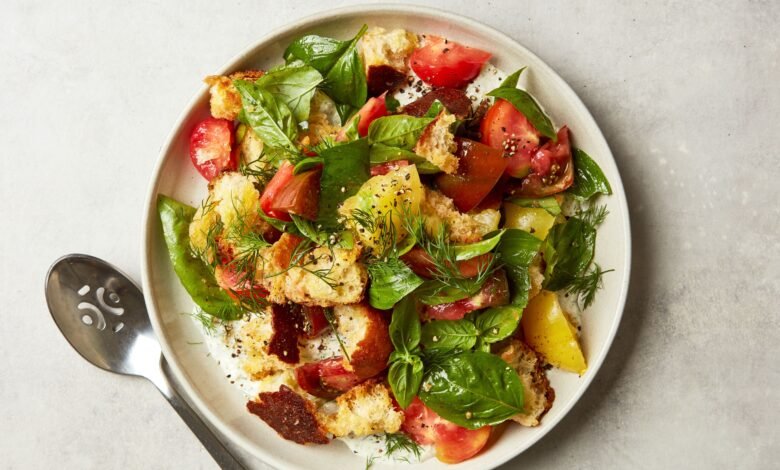
Stale bread may not look like dinner. Sitting on the counter, hardening by the hour, it probably feels like one more thing that got away from you. But turn it into panzanella, and suddenly it’s clear that you let that loaf dry out on purpose.
The Tuscan bread salad turns crusty, past-its-prime bread into something to actively look forward to: craggy crouton-like nuggets plumped with the juices of fresh summer tomatoes and a tangy vinaigrette, slicked with grassy olive oil, and tossed with enough vegetables, herbs, and other good things to qualify as a meal.
That transformation is the point. Panzanella isn’t a salad with croutons. The bread is the salad. Everything else is there to season it, soften it, sharpen it, or give it something to push against.
And once you understand that, panzanella becomes less a recipe than a framework. Peak-summer tomatoes are terrific, but cucumbers, stone fruit, roasted peppers, citrus, bitter greens, and plenty of other ingredients can supply the flavorful moisture the bread needs. Bon Appétit’s own archive ranges from spring panzanella with cucumber and asparagus to versions built around beets and rye.
The goal, whatever goes into the bowl, is the same: bread that is tender and seasoned all the way through but still has enough structure to fight back.
Panzanella is part of an Italian cooking tradition called “cucina povera” (peasant cuisine), having developed as a practical way to make stale bread worth eating. Its most familiar form combines sturdy bread (either stale or intentionally dried) with ripe tomatoes, olive oil, vinegar, onion, and herbs.
But the formula is more useful than any fixed ingredient list: sturdy bread + flavorful liquid + fat + acid + contrast.
That last part can take many forms. Something crunchy. Something creamy. Something bitter, salty, or fresh. Beans or cheese can turn it into dinner. Fruit can make it juicy. Pickled peppers or capers can wake everything up. The only nonnegotiable ingredient is the bread.
This is not the moment for pillowy sandwich bread. The best bread for panzanella has enough structure to absorb a considerable amount of liquid without surrendering completely. Country bread, sourdough, ciabatta, and crusty baguettes are all dependable choices. Rye and other whole-grain loaves pair especially well with beets, citrus, or bitter greens.
Whatever loaf you use, it needs to be firm enough to absorb dressing without falling apart. Naturally stale bread is traditional, but you do not need to schedule your salad around the aging process of a baguette. Staling isn’t strictly a matter of bread drying out: As bread sits, its starches reorganize, and the crumb becomes firmer. If your loaf is fresh, you can mimic the texture you need by drying it in the oven, grilling it, or frying it. All four methods work; they just give you different textures.
Traditional: Stale bread – If your bread is already firm and past its prime, congratulations: Dinner is halfway done. Stale, crusty bread readily absorbs oil, vegetable juices, and dressing while holding its shape longer than a soft, fresh loaf. Exactly how stale is stale enough? Skip the calendar. You want bread that has clearly dried out but is not so hard that it needs a geological survey before dinner.
Tear the loaf into generous, craggy chunks rather than neat little cubes, and err on the side of bigger pieces. The irregular edges catch dressing, while the larger centers take longer to saturate.
Foolproof: Oven-dried bread – No stale loaf? Tear fresh bread into roughly 1½–2-inch pieces and dry it in a 350°F oven until crisp through but not deeply browned, about 15–20 minutes depending on the bread. You are not making aggressively toasted croutons here. The point is to remove moisture so the bread has room to take on better-tasting liquid later. You can take the bread out of the oven when it’s just dry with no coloring for a more delicate flavor, or take it to golden brown for a panzanella with more robust ingredients.
Most flavorful: Grilled bread – Grilling does two jobs at once: It dries the bread and adds char. Brush thick slices with olive oil, grill until marked and crisp around the edges, then tear them once cooled. The uneven toastiness is a feature. Some bites stay chewy; others pick up smoke and crunch.
Crunchiest: Fried bread – If panzanella is already an argument for eating bread and oil for dinner, frying the bread simply commits to the premise. Pan-fry thick slices on one side only. The browned side remains crunchy while the other stays porous enough to drink in tomato juice and vinaigrette. It is a small maneuver with an excellent payoff: crisp and soaked bread in the same bite.
Ripe tomatoes are the classic choice for panzanella because they bring acidity, sweetness, and an enormous amount of flavorful liquid. But you can make panzanella without tomatoes. The bread simply needs something delicious to absorb. That could be ripe tomatoes, but it could just as well be smashed cucumbers, salted peaches or plums, jarred roasted peppers, citrus, or even the juices from cooked vegetables.
For especially watery produce, salt it before assembling the salad and let it drain in a strainer over a bowl. Salting concentrates the flavor of the produce, and the flavorful juices you collect in the bowl below can be whisked into your dressing instead of pooling at the bottom of the finished salad.
Bread and olive oil are delicious, but they can easily mute timid seasoning. The vinaigrette for your panzanella should taste a little punchier than one intended for tender lettuce. Red wine vinegar and extra-virgin olive oil are great starting points, but this is an excellent place to let the rest of your ingredients steer.
Stone fruit might want pickle brine. Spring vegetables can handle lemon or buttermilk. Bitter chicories can take balsamic or orange. A little mustard, chili crisp, or grated garlic can supply extra force. Importantly, use olive oil that tastes good. Or, if another flavorful fat is already part of your salad—say, rendered bacon fat—put it to work. In a salad this simple, there is nowhere for flat, wan ingredients to hide.
Once the bread is right, you have considerable freedom. But that does not mean every orphaned ingredient in the refrigerator belongs in the bowl. Choose additions that do a job: Fresh basil, mint, parsley, dill, or tarragon wake up all that bread and oil. Bitter radicchio can offset juicy fruit. Beans, eggs, chicken, tuna, steak, salami, or cheese can turn the salad into a full meal. Capers, olives, pickled peppers, or thinly sliced onion bring concentrated hits of salt and acid.
Cheese is nearly always welcome. Feta, mozzarella, ricotta salata, Parmesan, and Pecorino all work, depending on what else is going on. Or steal the trick from Fried-Bread Panzanella With Ricotta and Herbs and spoon the entire salad over a bed of seasoned ricotta.
The dreaded soggy panzanella usually comes from one of three things: bread that was too soft to begin with, too much uncontrolled liquid, or too much time. The single best defense against bad panzanella? Do not pour all the dressing over the salad and hope for the best. Add some, toss, and wait. Taste a piece of bread. If its center is still dry or chalky, add a little more dressing and give it another few minutes—you’re looking for a texture we affectionately call crispy-gone-soggy. Repeat until the bread is seasoned through, tender but still intact.
You do not need an exact recipe once you understand the mechanics:
Start with sturdy bread and let it stale, toast it, grill it, or fry it.
Season something juicy (tomatoes, cucumbers, stone fruit, roasted vegetables) and collect any flavorful liquid it releases.
Make a bright dressing with olive oil and vinegar, citrus, cultured dairy, pickle brine, or a combination.
Add contrast with vegetables, herbs, aromatics, cheese, beans, eggs, meat, or fish.
Dress the bread gradually, letting it absorb each addition before deciding whether it needs more.
Rest and taste. Adjust the salt, acid, pepper, and olive oil when the bread is tender, thoroughly seasoned, and still holding together.
That’s the whole mission: bread and oil for dinner, with enough vegetables thrown in to call it a salad.
Source: www.bonappetit.com