

Building on its long-running Program of Record with the US Navy, Raytheon is stepping up its export pursuits for its AN/SPY-6(V) S-band Air and Missile Defense Radar (AMDR) family, positioning the system for key frigate programs in Germany, Japan, and Denmark.
Germany has already selected AN/SPY-6 as the prime sensor for its new F127 air defense frigates, while Japan is considering the radar for its Mogami-class frigates. With AN/SPY-6(V)3 hardware assets potentially available for Foreign Military Sales (FMS) as a result of the US Navy’s decision to end the FFG-62 Constellation-class frigate programme, Raytheon is now positioning for other international opportunities while at the same time crafting plans to develop a global manufacturing and sustainment ‘ecosystem’ following a template already established on the Patriot ground-based air defense missile system.
Modular Architecture: Scaling the SPY-6 Family
AN/SPY-6(V) was originally developed to meet the US Navy’s requirement for a next-generation solid-state AMDR offering increased sensitivity, wider bandwidth and improved processing compared to the legacy AN/SPY-1D(V) radar. This AN/SPY-6(V)1 variant, supporting integrated air and missile defense through the Aegis Baseline 10 combat system equipping the new DDG-51 Flight III guided missile destroyers, uses four fixed arrays each populated with 37 Radar Modular Assemblies [RMAs]).
An RMA is a self-contained radar antenna packaged in a 2 x 2 x 2 ft box. The fact that these individual ‘building blocks’ can be stacked and scaled into different sized apertures to suit different mission requirements has subsequently been leveraged to serve as the foundation for a broader AN/SPY-6(V) family of radars: AN/SPY-6(V)4 is the AMDR backfit radar, comprising 24 RMAs per face, for DDG-51 Flight IIA guided missile destroyers; AN/SPY-6(V)2 is the Enterprise Air Surveillance Radar (EASR) Rotator featuring nine RMAs in a single array face; and AN/SPY-6(V)3 is the EASR Fixed Face featuring three fixed-face array faces each with nine RMAs.
Production Ramping Up at Andover Facility
AN/SPY-6 radars are now on board two commissioned US Navy ships and installed on 11 others in various stages of testing, according to Jen Gauthier, vice president of Naval Systems & Sustainment at Raytheon. “We’re in full rate production for SPY-6 and we just signed a few weeks ago a $1.8 billion contract with the US Navy for a two-year extension of that production contract,”she told Naval News. “So that’s several new radars, which will of course benefit any other customers that from an FMS perspective.”
Evaluating Options for Germany’s F127 Frigates
Raytheon was in June this year awarded a separate NAVSEA contract, worth over $500 million, for AN/SPY-6 design agent services. “This is for engineering support work, integration, test support for the US Navy, and also for the German Navy,” said Gauthier. “Germany announced [last year] that they intend to use SPY-6 on their new F127 frigates, and so we are working right now to ensure that we not only have the capacity in the factory, but that we’re also doing some early work in [preparation] for that work.”
The original FMS case, forming part of a wider Aegis weapon system package for the eight-ship F127 programme, specified the AN/SPY-6(V)1 radar variant. However, Gauthier revealed that this choice is currently the subject of review.
“They are looking at different ways to make the F127 more affordable and be able to get there a little bit sooner,” she said. “They’re exploring several other subsystems, not just the radar, and the overall design of the ship. For instance, going from a double deck to a single deck – that will have implications for the design of the radar.”
“So we are working very closely with the Germans on that, ensuring that they have all the information that they need to help make that decision. We’ve also been working very closely with them on exploring some options for in-country support [and] supplier support, which again will be very important to them.”
Competing for Japan’s Upgraded Mogami-class
Raytheon is also pitching AN/SPY-6 to Japan, which is looking to introduce a new solid-state radar on its new generation vessels. It faces competition from Lockheed Martin, which is offering a variant of its AN/SPY-7 radar.
The Japanese Maritime Self-Defense Force (JMSDF) is expected to complete an options study later this year, and will subsequently share a recommendation with the Japanese Ministry of Defense for final approval. A selection announcement is planned for early 2027.
“We’ve been working very closely with Japan,” Gauthier said, “and we already have partnerships in place with Japanese industry to do some development and production work. That is not just in the event that the [JMSDF] selects SPY-6. They will supply our global fleet.”
Mitsubishi Electric Corporation (MELCO) and Sampa Kogyo announced in 2024 that they had concluded agreements with Raytheon to supply AN/SPY-6(V) radar components for the US Navy. Both MELCO and Sampa Kogyo have extensive experience in radar-related products.
“Those Japanese suppliers will be producing subsystems for SPY-6 radars for the United States and for the global fleet,” said Gauthier. “We really see value in expanding our supply base globally to support the global fleet, not just for whatever country those companies happen to be in.”
Early Pursuits in Denmark and International Expansion
As it progresses pursuits in Germany and Japan, Raytheon is also looking at new opportunities for AN/SPY-6 in the international marketplace. Its position has been helped by the availability of AN/SPY-6(V)3 hardware previously destined for the FFG-62 Constellation-class frigate programme. “We no longer need those assets for our existing contracts with the US Navy,” Gauthier acknowledged. “So there is certainly potential for some earlier availability of hardware than may otherwise have been available.”
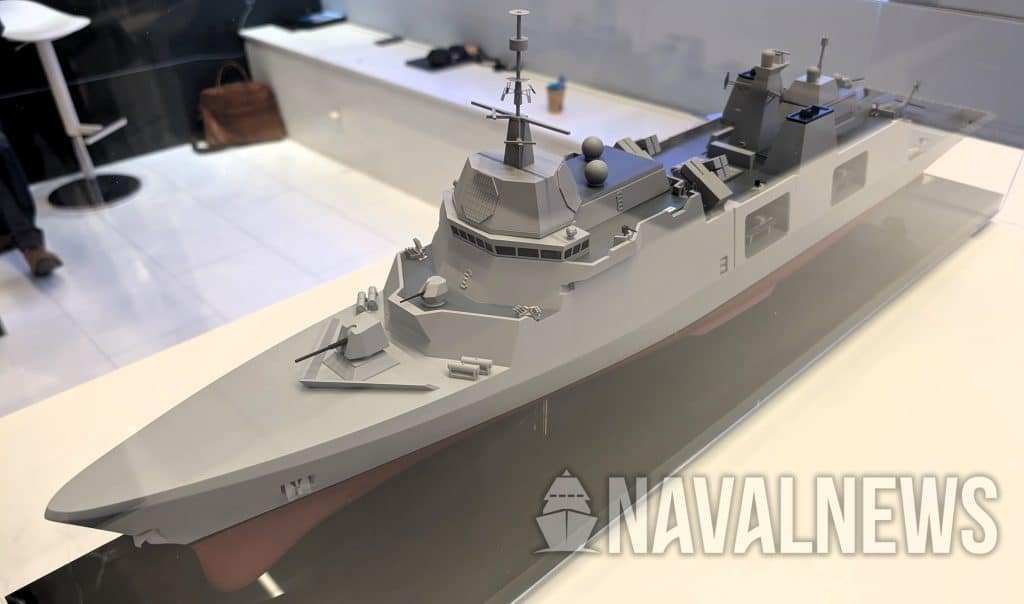
Denmark, which is planning new frigates, has already been identified as a potential market: Gauthier confirmed to Naval Newsthat early engagement with the Danish Defence Acquisition and Logistics Organisation was underway.
Raytheon is unwilling at this stage to discuss contacts with potential bidders – both shipbuilders and combat system suppliers – lining up for the Danish competition.“What I can say, through our work on SPY-6 but also on a lot of the other systems that we work on at Raytheon, is that we have very good relationships with several of those shipbuilders and several [suppliers of] combat management systems,” observed Gauthier. “We’re exploring opportunities that would benefit not only Denmark, but some other partners as well.”
Building a Global Sustainment Ecosystem
Alongside interoperability with the US Navy, and the opportunity for international partners to leverage prior US government investment in development and testing, Raytheon sees customer nation participation in the AN/SPY-6 supply and sustainment ecosystem as a key pillar of its pitch to the market. “The more that SPY-6 proliferates globally, the more benefit that all of these partner nations will get,” said Gauthier. “We tend to look at this as an opportunity that’s similar to the Patriot Global Family, where all those participating countries get a benefit from multiple bill payers.”
She continued: “The US Navy has expressed an interest to make sure that we have a very, very robust repair and return depot and sustainment system for SPY-6. It’s about working with local suppliers, making [them] part of that global system. So, not just making parts for whatever nation that happens to be in, we want them to be part of the global family.”
“Again, it’s building that global supply base, the sustainment arm, and cost sharing for things like technology maturation and insertion over time. All of those benefits become even more beneficial as more nations join the SPY-6 family.”
CMS-Agnostic Flexibility
The flexibility and adaptability resident in AN/SPY-6 to match specific national needs is another argument deployed by Raytheon in the international market. “It’s combat management system agnostic,” said Gauthier.“So while it is being integrated with Aegis Baseline 10 today on the [DDG-51] Flight III destroyers, SPY-6 does not need Aegis.”
“We’ve actually done some of our own work with IRAD [internal research and development] dollars. We were able to demonstrate, for very little investment and in a very short period of time, our ability to work with and within other combat management systems, and provide data directly to the missiles. So we feel like that is an advantage for SPY-6 globally because it will allow other countries to select the radar even if they are not part of the Aegis family.”
Source: www.navalnews.com