

In 2007, a piece of space debris punched a bullet-like hole through the radiator panel of the US space shuttle Endeavor. The shuttle program ended in 2011, but the space debris problem has only intensified as we launch more and more satellite constellations, telescopes, and spacecraft into orbit. That’s why Chinese scientists have devised a new aluminum material inspired by eggshells that they believe could offer enhanced protection against debris fragments, according to a new paper published in the Journal of Applied Physics.
Eggshells have long fascinated scientists because of their mechanical properties. For instance, it’s well known that cracking an egg requires applying just enough force to the center to achieve a clean break without completely shattering the shell. In 2012, MIT mechanical engineer Pedro Reis co-authored a paper demonstrating the link between an egg’s ovoid geometry and its rigidity, a major factor when predicting how much force an object can endure before cracking. (As I wrote for Slate at the time, rigidity is related to, but distinct from, strength. If one eggshell has tiny cracks and the other doesn’t, both shells have different strengths—the cracked one will break more easily—but the same rigidity.)
Reis started studying eggshells after participating in a popular physics demonstration: walking on cartons of eggs without breaking them. The key, he learned, was to align the eggs with their narrow tip (the most crack-resistant part) pointing up, and then carefully place one’s feet to distribute one’s weight over the entire surface area. This ensures that no single egg is overloaded. While it takes around 5.5 pounds of force to crack an egg, that depends on the direction in which the force is applied, as well as its distribution over the shell’s surface.
In the 1950s and 1960s, the aerospace industry
In the 1950s and 1960s, the aerospace industry found eggshells’ resistance to shattering to be a useful model when conducting failure analysis studies of the metal shells used to build airplanes. That crack resistance is because of their structure, which is similar to tooth enamel or seashells. An eggshell is mostly comprised of calcium carbonate crystals embedded in a protein matrix, further bolstered by a thin collagen inner membrane. It’s been described as “nature’s perfect packaging” for that reason.
Another popular demonstration is the classic egg-drop challenge, in which students must figure out how best to protect a single egg from breaking when dropped from a significant height. The longtime assumption has always been that dropping the egg vertically is best, which is consistent with Reis’s 2012 work.
But earlier this year, Reis’s MIT colleague, Tal Cohen—whose department leads MIT’s annual egg drop challenge—decided to test that assumption. The team found that in situations where energy absorption is a critical factor, like the egg drop, horizontal eggs absorb more energy and can compress more under the same amount of force. Their follow-up experiments bore this out: horizontally positioned eggs cracked less frequently than vertical ones when dropped from the same height.
Eggshells in spaaaaace!
NASA computer-generated image of growth of space debris
NASA computer-generated image of growth of space debris.
NASA/Public domain
NASA computer-generated image of growth of space debris.NASA/Public domain
Illustration of a satellite breaking up into multiple pieces at higher altitudes.
ESA/ID&Sense;/ONiRiXEL/CC BY-SA 3.0 igo
Illustration of a satellite breaking up into multiple pieces at higher altitudes.ESA/ID&Sense;/ONiRiXEL/CC BY-SA 3.0 igo
Space Shuttle Endeavour had a major impact on its radiator during STS-118. The entry hole is about 5.5 mm (0.22 in), and the exit hole is twice as large.
NASA/Public domain
Space Shuttle Endeavour had a major impact on its radiator during STS-118. The entry hole is about 5.5 mm (0.22 in), and the exit hole is twice as large.NASA/Public domain
Illustration of a satellite breaking up into multiple pieces at higher altitudes.ESA/ID&Sense;/ONiRiXEL/CC BY-SA 3.0 igo
Space Shuttle Endeavour had a major impact on its radiator during STS-118. The entry hole is about 5.5 mm (0.22 in), and the exit hole is twice as large.NASA/Public domain
So eggshell physics is complicated, and scientists are still learning new things and finding novel applications for what they’ve learned—such as protection from space debris. A NASA report from 2021 estimated that there are around 34,000 pieces of debris larger than 10 centimeters in near-Earth orbit, about 900,000 pieces between 1 cm and 10 cm, and roughly 128 million pieces smaller than 1 cm. Even the smallest debris particles can damage spacecraft because of the high velocities they can achieve.
Spacecraft are typically protected from debris impacts by some form of a Whipple shield, which has a thin outer bumper with a space between the bumper and the wall of the spacecraft. The bumper is designed to break up any incoming debris particles, spreading the impact energy over a larger area of the wall. There have been many iterations of the Whipple shield over the decades, including designs with multiple bumpers, or with a filling between the rigid layers (“stuffed” Whipple shields).
The authors of this latest paper wanted
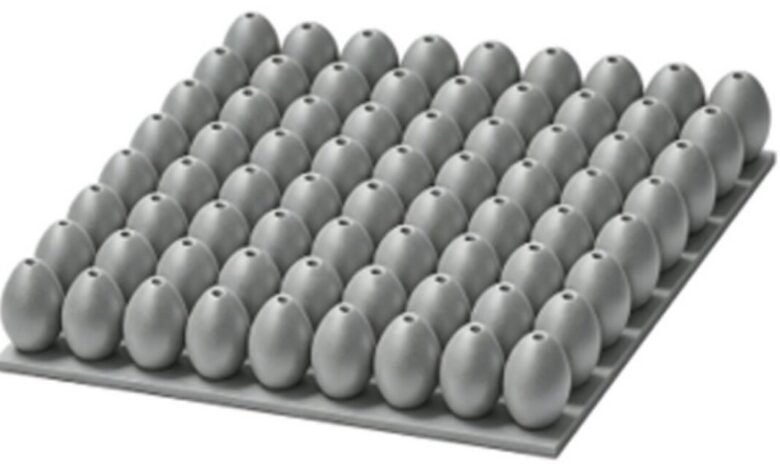
The authors of this latest paper wanted to enhance the impact resistance of Whipple shields. They came up with a design similar in concept to the trick for walking across cartons of eggs, drawing on the favorable geometry and biomechanical properties of eggshells. The team 3D-printed three different aluminum designs: just aluminum plates, water-filled aluminum spheres sandwiched between aluminum plates, and eggshell structures filled with water. They ran multiple simulations measuring hypervelocity impacts to determine the most impact-resistant design and conducted light-gas gun experiments on their 3D-printed arrays.
The water-filled eggshell-shaped arrays proved the most effective, withstanding high loads and reducing the velocity of projectiles by nearly 65 percent. Using just aluminum plates reduced the velocity by only 51 percent. The water filling plays an important role in dissipating impact energy, preventing impact waves from propagating as it sloshes around inside the shell.
The authors also tested different eggshell configurations and found that the most effective was one with the eggs placed upright with the narrow tip in contact with the top aluminum plate. More experiments are needed to refine the design and improve the material’s energy absorption, but these initial results are promising.
A single eggshell breaks easily under local force,
“A single eggshell breaks easily under local force, but the protection mechanism of the eggshell array is completely different,” said co-author Yuxin Wang of Dalian University of Technology in China. “The cooperative deformation of these eggshell units transforms the local impact load into distributed energy dissipation across the metastructure, thereby significantly enhancing the anti-impact performance of the target plates. We hope this research can attract more attention to bio-inspired protective structures.”
Journal of Applied Physics, 2026. DOI: 10.1063/5.0324502 (About DOIs).

Jennifer OuelletteSenior Writer
Jennifer OuelletteSenior Writer
Jennifer is a senior writer at Ars Technica with a particular focus on where science meets culture, covering everything from physics and related interdisciplinary topics to her favorite films and TV series. Jennifer lives in Baltimore with her spouse, physicist Sean M. Carroll, and their two cats, Ariel and Caliban.
Source: arstechnica.com